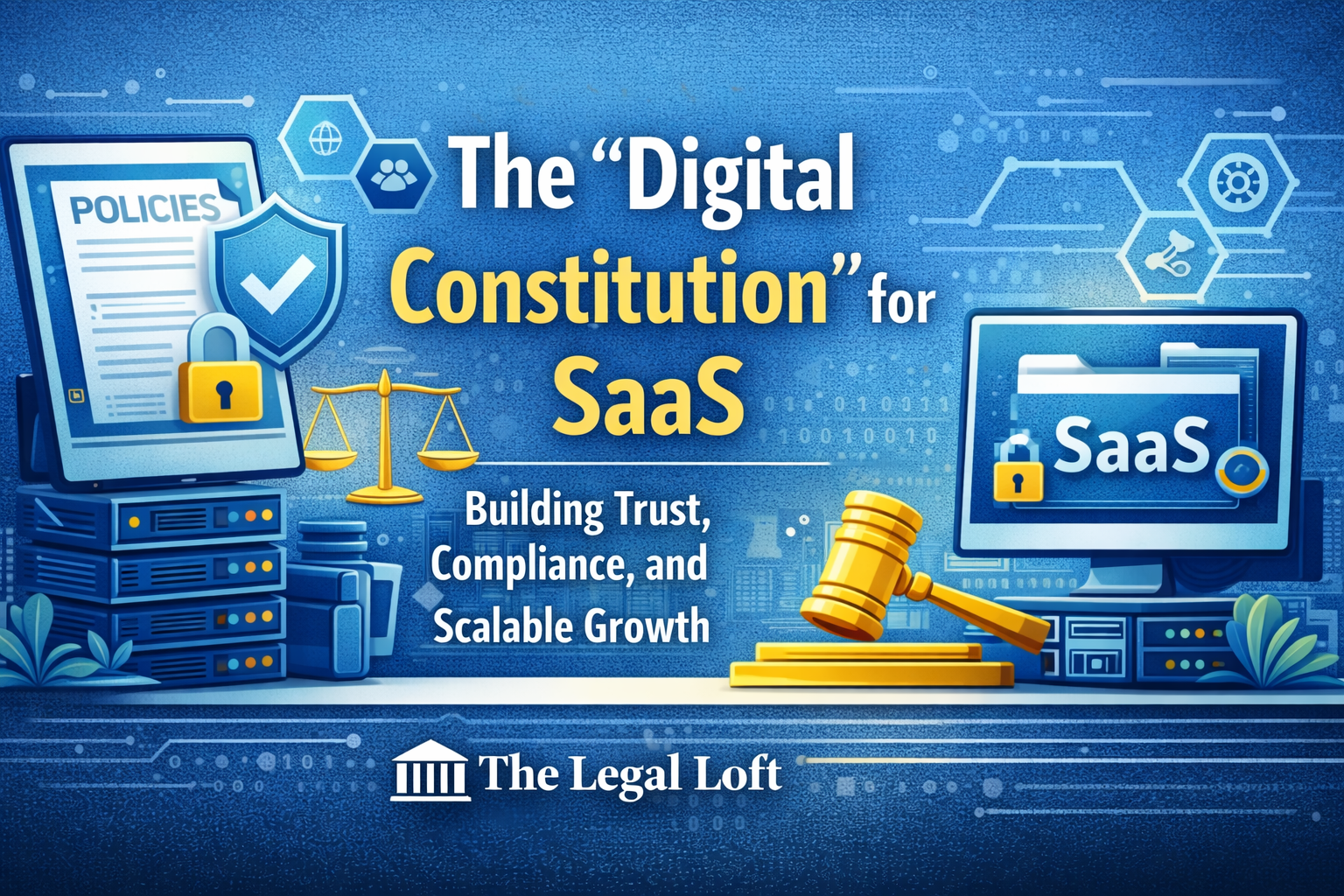
Software-as-a-Service (SaaS) companies are no longer just technology providers — they are governors of digital ecosystems. From managing user data and defining platform rules to enforcing access controls and automated decisions, SaaS businesses exercise significant power over users, customers, and even markets.
This evolving role has given rise to a new idea:
the “Digital Constitution” for SaaS companies.
Just as a national constitution defines rights, duties, and limits of power, a Digital Constitution sets the legal, ethical, and governance framework for SaaS platforms operating in the digital economy.
What Is a “Digital Constitution” for SaaS?
A Digital Constitution for SaaS refers to a structured set of policies, principles, and legal safeguards that govern how a SaaS platform:
- Collects and processes data
- Grants or restricts access
- Uses algorithms and automation
- Resolves disputes
- Protects user rights
It transforms scattered legal documents into a coherent governance system aligned with digital rights and regulatory expectations.
For SaaS companies, this is not theory — it is operational law.
Why SaaS Companies Need a Digital Constitution
SaaS platforms operate at the intersection of:
- Technology
- Contracts
- Data protection
- Consumer protection
- Cross-border regulations
Without a clear internal legal framework, SaaS companies face:
- Regulatory penalties
- Contractual disputes
- Data breaches and trust erosion
- Investor red flags
A Digital Constitution ensures predictability, transparency, and accountability, which are critical for scaling.
Core Pillars of a SaaS Digital Constitution
1. Data Rights and Privacy Governance
Data is the backbone of SaaS businesses — but it is also heavily regulated.
A Digital Constitution must clearly define:
- What data is collected
- Why it is collected
- How long it is retained
- Who has access
- How users can exercise their rights
With laws such as:
- GDPR
- India’s Digital Personal Data Protection Act, 2023
- Global data localization norms
Privacy-by-design is no longer optional.
2. User Rights and Platform Fairness
SaaS platforms frequently:
- Suspend accounts
- Limit features
- Terminate subscriptions
Without transparent rules, these actions can be challenged as arbitrary.
A Digital Constitution must include:
- Clear Terms of Service
- Fair usage policies
- Due process mechanisms
- User grievance redressal
This mirrors constitutional principles of fairness and natural justice in the digital environment.
3. Algorithmic Transparency and Automation Controls
Many SaaS platforms rely on:
- Automated decision-making
- AI-driven recommendations
- Risk scoring or access control algorithms
Unchecked automation can lead to:
- Bias
- Discrimination
- Regulatory scrutiny
A Digital Constitution requires:
- Defined limits on automation
- Human oversight for high-impact decisions
- Documented logic and accountability
This is increasingly important for AI-powered SaaS products.
4. Access Control and Digital Due Process
Who gets access to your platform — and who doesn’t — is a powerful decision.
SaaS Digital Constitutions should define:
- Conditions for suspension or termination
- Notice and explanation requirements
- Appeal and review mechanisms
This protects both users and the platform from legal disputes.
5. Compliance-by-Design Architecture
Rather than reacting to regulations, SaaS companies must embed compliance into their systems.
This includes:
- Continuous monitoring of legal changes
- Automated compliance checks
- Audit-ready documentation
- Cross-border compliance mapping
This is known as always-on compliance, a core feature of modern SaaS governance.
Why a Digital Constitution Matters for SaaS Startups
For early-stage and growth-stage SaaS startups, a Digital Constitution delivers tangible benefits:
- Faster enterprise onboarding
- Easier fundraising and due diligence
- Reduced regulatory and litigation risk
- Stronger customer trust
- Clear internal decision-making
Investors increasingly evaluate governance maturity alongside product-market fit.
Indian and Global Regulatory Context
SaaS companies today operate in a complex regulatory environment shaped by:
- Data protection laws
- Consumer protection rules
- IT intermediary obligations
- Sector-specific regulations
Indian SaaS companies serving global markets must align with international legal expectations, even when operating locally.
Courts and regulators are also increasingly applying constitutional values to private digital platforms, making governance a legal necessity.
How SaaS Companies Can Build Their Digital Constitution
To implement a Digital Constitution, SaaS companies should:
- Consolidate legal policies into a unified governance framework
- Regularly audit data flows and automation
- Define clear internal compliance ownership
- Train teams on digital rights and obligations
- Work with legal advisors who understand SaaS and technology law
The goal is not paperwork — it is operational clarity.
The Future of SaaS Governance
As SaaS platforms continue to shape digital infrastructure, regulators, courts, and users will demand:
- Greater transparency
- Fairer platform governance
- Stronger digital rights protections
SaaS companies that adopt Digital Constitutionalism early will lead the next phase of responsible innovation.
Conclusion
The Digital Constitution for SaaS is not just a legal framework — it is a strategic foundation.
By defining rights, responsibilities, and limits of power, SaaS companies can scale confidently, earn trust, and future-proof their businesses in an increasingly regulated digital world.
In the SaaS economy, good governance is good business.
Need Help Structuring Your SaaS Legal Framework?
At The Legal Loft, we help SaaS companies design Digital Constitutions, ensure data protection compliance, and build scalable legal governance models.
📩 Let’s future-proof your SaaS platform.