
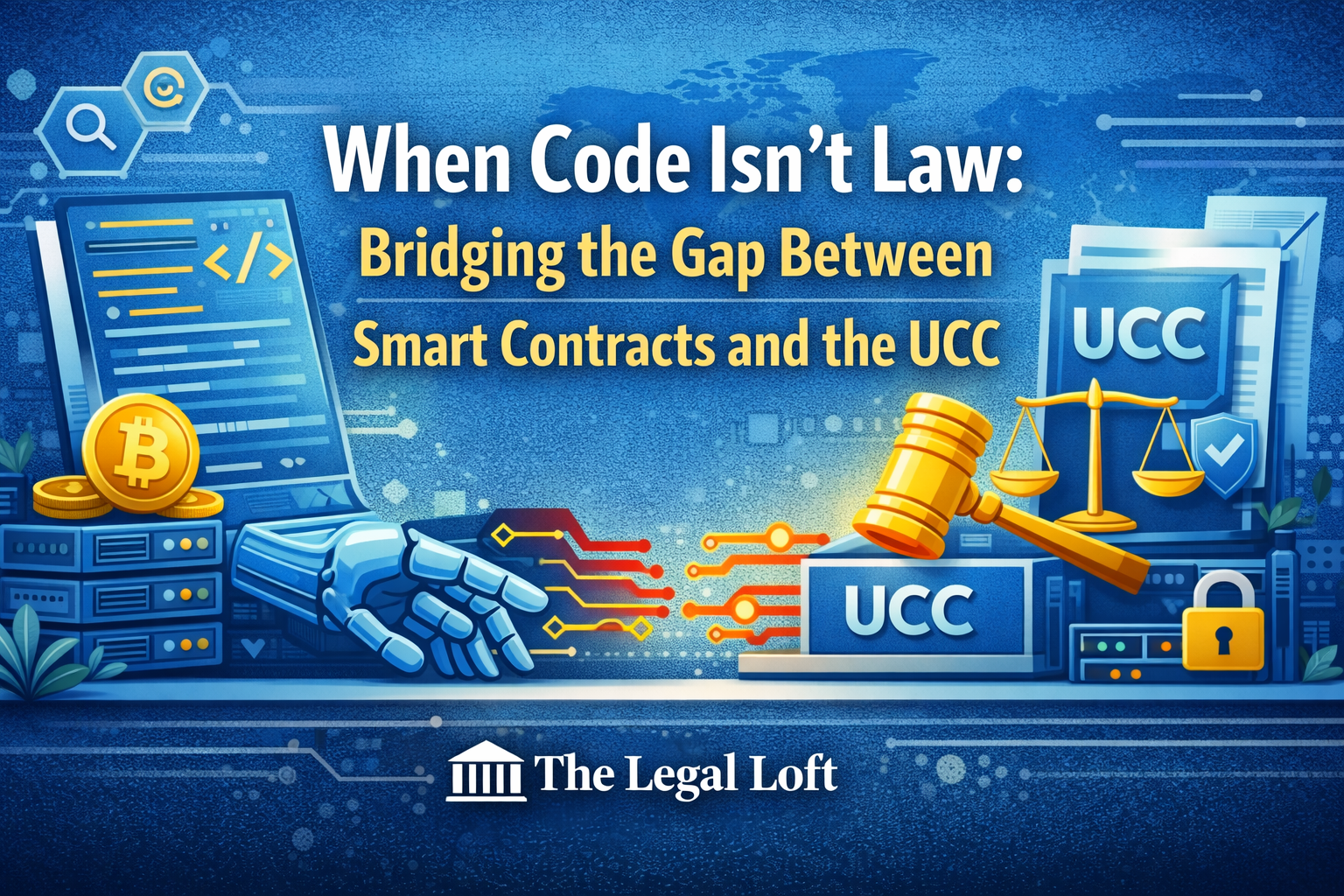
Introduction: The Myth That “Code Is Law”
In the Web3 and blockchain ecosystem, one phrase is repeated almost like gospel: “Code is law.” Smart contracts—self-executing agreements written in code—promise efficiency, automation, and trustless transactions. For startups building on blockchain, this sounds like the future of commerce.
But here’s the legal reality: code alone is not law.
When disputes arise, courts do not interpret Solidity or Python—they interpret legal intent, statutory frameworks, and commercial reasonableness. In the United States (and increasingly influencing global trade), that framework is the Uniform Commercial Code (UCC).
This blog explores why smart contracts still need legal grounding, how the UCC applies to digital transactions, and how startups can bridge the growing gap between automated code and enforceable law.
Understanding Smart Contracts Beyond the Hype
Smart contracts are programs that automatically execute predefined actions once certain conditions are met. They excel at:
- Automating payments
- Reducing intermediaries
- Ensuring transparency
- Speeding up transactions
However, smart contracts do not inherently understand:
- Fraud
- Mistake
- Duress
- Capacity
- Commercial fairness
These are legal concepts—not technical ones.
If a smart contract executes incorrectly due to a bug, oracle failure, or exploit, the blockchain may say the transaction is final. The law does not always agree.
Where Smart Contracts Collide with the UCC
The Uniform Commercial Code (UCC) governs commercial transactions involving goods, secured transactions, negotiable instruments, and—more recently—digital assets.
Key UCC Principles That Code Can’t Replace
- Intent of the Parties
Courts prioritize what parties intended, not just what the code executed. - Good Faith & Fair Dealing
Automation does not override the obligation to act honestly and fairly. - Error & Mistake
A smart contract can execute a mistake flawlessly—legally, that still may be voidable. - Remedies & Enforcement
The UCC allows rescission, damages, and equitable relief—none of which exist on-chain by default.
Smart Contracts as “Agreements” Under the UCC
Under UCC § 2-204, a contract can be formed “in any manner sufficient to show agreement.” This means:
✅ Smart contracts can form valid contracts
❌ Smart contracts alone may not define the entire agreement
Courts often look beyond the code to:
- Whitepapers
- Terms of Service
- Off-chain agreements
- Platform policies
- User communications
The smart contract becomes evidence—not the entire contract.
The Rise of UCC Article 12 and Digital Assets
To address modern commerce, the UCC introduced Article 12, recognizing “Controllable Electronic Records (CERs)”—including digital assets and tokenized rights.
This development is critical for blockchain startups because it:
- Legally recognizes control of digital assets
- Enables secured lending using crypto assets
- Clarifies ownership disputes
- Bridges traditional commercial law with Web3 infrastructure
However, Article 12 still relies on legal interpretation, not technical execution alone.
Why “Code Is Law” Fails in Real Disputes
Scenario 1: Bug-Induced Asset Transfer
A DeFi protocol executes a transfer due to a coding error. On-chain: valid. In court: possibly unjust enrichment.
Scenario 2: Smart Contract vs. Consumer Protection
An automated liquidation clause triggers unfairly. Consumer law and UCC protections may override the code.
Scenario 3: Jurisdictional Conflicts
Code executes globally—but laws apply locally. Courts will enforce jurisdictional statutes, not blockchain ideology.
Bridging the Gap: Legal + Technical Design
For startups, the solution isn’t choosing between law and code—it’s integrating both.
Best Practices for Startups Using Smart Contracts
- Dual-Layer Contracting
- Pair smart contracts with traditional legal agreements
- Clearly define precedence in case of conflict
- Legal Intent Clauses
- Explicitly state parties’ intent and governing law
- Reference the smart contract as an execution tool
- Dispute Resolution Mechanisms
- Arbitration clauses
- Off-chain enforcement pathways
- Compliance-by-Design
- Align smart contract logic with UCC requirements
- Account for mistake, termination, and remedies
- Audit Beyond Code
- Legal audits alongside technical audits
- Especially critical for asset-backed tokens and DeFi platforms
Why This Matters for Startups and Investors
Investors increasingly ask:
- Is this legally enforceable?
- What happens in a dispute?
- How does this comply with commercial law?
Startups that ignore legal foundations risk:
- Unenforceable agreements
- Regulatory action
- Investor hesitation
- Litigation exposure
Those that embrace legal-smart contract alignment gain:
- Stronger credibility
- Easier fundraising
- Reduced risk
- Scalable compliance
Conclusion: Law Still Governs Code
Smart contracts are powerful tools—but they are not substitutes for law.
The future of digital commerce lies in legal engineering, where:
- Code executes
- Law interprets
- Courts enforce
- Businesses scale securely
At The Legal Loft, we help startups design contracts where code works with the law—not against it. Because in the real world of commerce, law still decides when code fails.