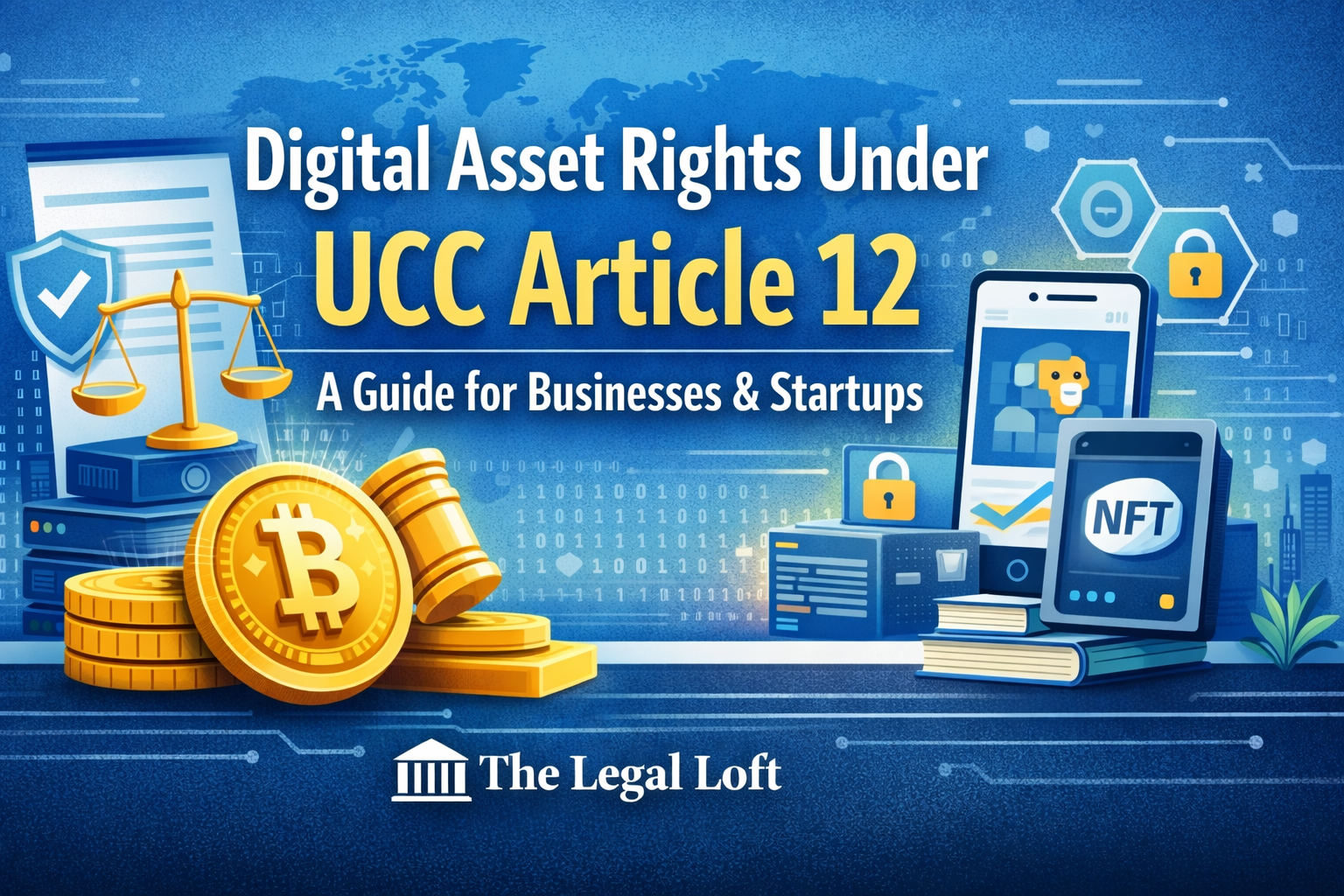
As digital assets become central to modern commerce, legal systems across the world are racing to keep up. Cryptocurrencies, NFTs, tokenized assets, and electronic records are no longer fringe innovations — they are now part of mainstream financial and commercial transactions.
To address this shift, the United States introduced UCC Article 12, a landmark legal framework that formally recognizes and governs Digital Asset Rights.
For startups, fintech companies, Web3 platforms, and global businesses, understanding UCC Article 12 is essential for legal certainty, risk management, and cross-border operations.
What Is UCC Article 12?
UCC Article 12 is a newly adopted article under the Uniform Commercial Code (UCC) in the United States. It specifically deals with Controllable Electronic Records (CERs) — a category designed to include modern digital assets such as:
- Cryptocurrencies
- NFTs (Non-Fungible Tokens)
- Tokenized financial instruments
- Blockchain-based digital assets
Article 12 provides a legal framework for ownership, transfer, control, and security interests in these assets.
In essence, it gives digital assets a status similar to traditional property under commercial law.
Why Was UCC Article 12 Introduced?
Before Article 12, digital assets existed in a legal grey area. Traditional UCC provisions were designed for physical goods, paper instruments, or centralized electronic records — not decentralized blockchain assets.
This created uncertainty around:
- Who legally “owns” a digital asset
- How rights are transferred
- Whether digital assets can be collateral
- How disputes should be resolved
UCC Article 12 fills this gap by modernizing commercial law for the digital economy.
Understanding “Controllable Electronic Records” (CERs)
At the heart of UCC Article 12 is the concept of control.
A Controllable Electronic Record is a digital record that:
- Can be subjected to control
- Is susceptible to exclusive access
- Can be transferred so that control passes to another party
Control typically exists when a person has:
- The power to benefit from the asset
- The ability to prevent others from accessing it
- The ability to transfer control to someone else
This mirrors how possession works for physical property, but in a digital context.
Key Legal Rights Recognized Under UCC Article 12
1. Ownership and Transfer of Digital Assets
Article 12 clearly recognizes that digital assets can be owned and transferred through control.
A person who obtains control of a CER in good faith and without notice of competing claims receives strong legal protection — similar to a bona fide purchaser under traditional property law.
This provides certainty for:
- Crypto transactions
- NFT marketplaces
- Tokenized asset platforms
2. Security Interests in Digital Assets
One of the most important features of Article 12 is its recognition of digital assets as collateral.
Lenders can now:
- Take security interests in digital assets
- Perfect their interest through control
- Enforce rights in case of default
This opens the door for:
- Crypto-backed loans
- Web3 financing
- Digital asset-based credit products
3. Priority Rules and Risk Allocation
UCC Article 12 establishes clear priority rules to resolve competing claims over the same digital asset.
Generally:
- A party with control has priority
- Good faith purchasers are protected
- Clear rules reduce litigation risk
This predictability is crucial for institutional adoption of digital assets.
Why UCC Article 12 Matters for Startups
For startups operating in fintech, blockchain, SaaS, or global commerce, Article 12 has real-world implications.
Legal Certainty
Clear recognition of digital asset rights reduces ambiguity and makes contracts enforceable.
Investor Confidence
VCs and institutional investors prefer businesses operating under clear legal frameworks.
Cross-Border Transactions
Even non-US startups benefit, as UCC standards often influence global commercial practices.
Product Innovation
Startups can now build products involving custody, lending, or transfer of digital assets with greater confidence.
Impact on Indian and Global Businesses
While UCC Article 12 is a US law, its influence extends globally.
- Many international contracts reference UCC principles
- Global investors expect compliance with modern asset frameworks
- Indian startups with US exposure must understand these rules
As India continues to develop its own digital asset regulations, frameworks like UCC Article 12 may serve as reference models for future legislation.
Compliance and Best Practices for Businesses
To align with UCC Article 12, businesses should:
- Clearly define control mechanisms in contracts
- Update terms of service for digital asset platforms
- Ensure secure custody and transfer systems
- Conduct legal audits of digital asset transactions
- Align internal policies with global best practices
Early compliance reduces legal and operational risks as regulation tightens.
The Future of Digital Asset Rights
UCC Article 12 represents a major step toward integrating digital assets into traditional commercial law. As adoption grows, we can expect:
- Greater institutional participation
- More regulated digital asset markets
- Increased cross-border harmonization
For businesses, the message is clear: digital assets are no longer outside the law — they are firmly within it.
Conclusion
Digital Asset Rights under UCC Article 12 mark a turning point in how the law treats blockchain-based and electronic assets. By recognizing ownership, control, and security interests, Article 12 provides the legal certainty that the digital economy urgently needs.
Startups and businesses that understand and adapt to this framework will be better positioned to innovate, scale, and attract global investment.
Need Legal Guidance on Digital Assets?
At The Legal Loft, we help startups and businesses navigate emerging digital asset laws, draft compliant contracts, and structure secure digital transactions.
📩 Get expert legal support for the future of digital commerce.