Introduction: AI Has Entered the Workplace — Has the Law Kept Up?
Artificial Intelligence is no longer a future concept in the workplace. From AI-powered hiring tools and productivity monitoring to automated performance evaluations and chatbots, AI is actively shaping employment decisions.
Yet most employee handbooks remain silent on AI.
This gap creates legal, ethical, and compliance risks. As organizations increasingly rely on workplace AI, the traditional employee handbook must evolve into a Digital-Era Governance Document—one that clearly defines rights, responsibilities, and safeguards around AI use.
Welcome to the era of the New Employee Handbook.
Why Workplace AI Needs Legal Guardrails
AI systems can:
- Screen resumes
- Monitor employee behavior
- Predict attrition
- Evaluate productivity
- Assist in disciplinary actions
While efficient, these systems can also:
- Introduce bias
- Violate privacy rights
- Enable discriminatory outcomes
- Reduce transparency in decision-making
Without clear legal safeguards, employers face:
- Employment litigation
- Regulatory penalties
- Employee distrust
- Reputational damage
An updated employee handbook is the first line of defense.
What Is the “New Employee Handbook”?
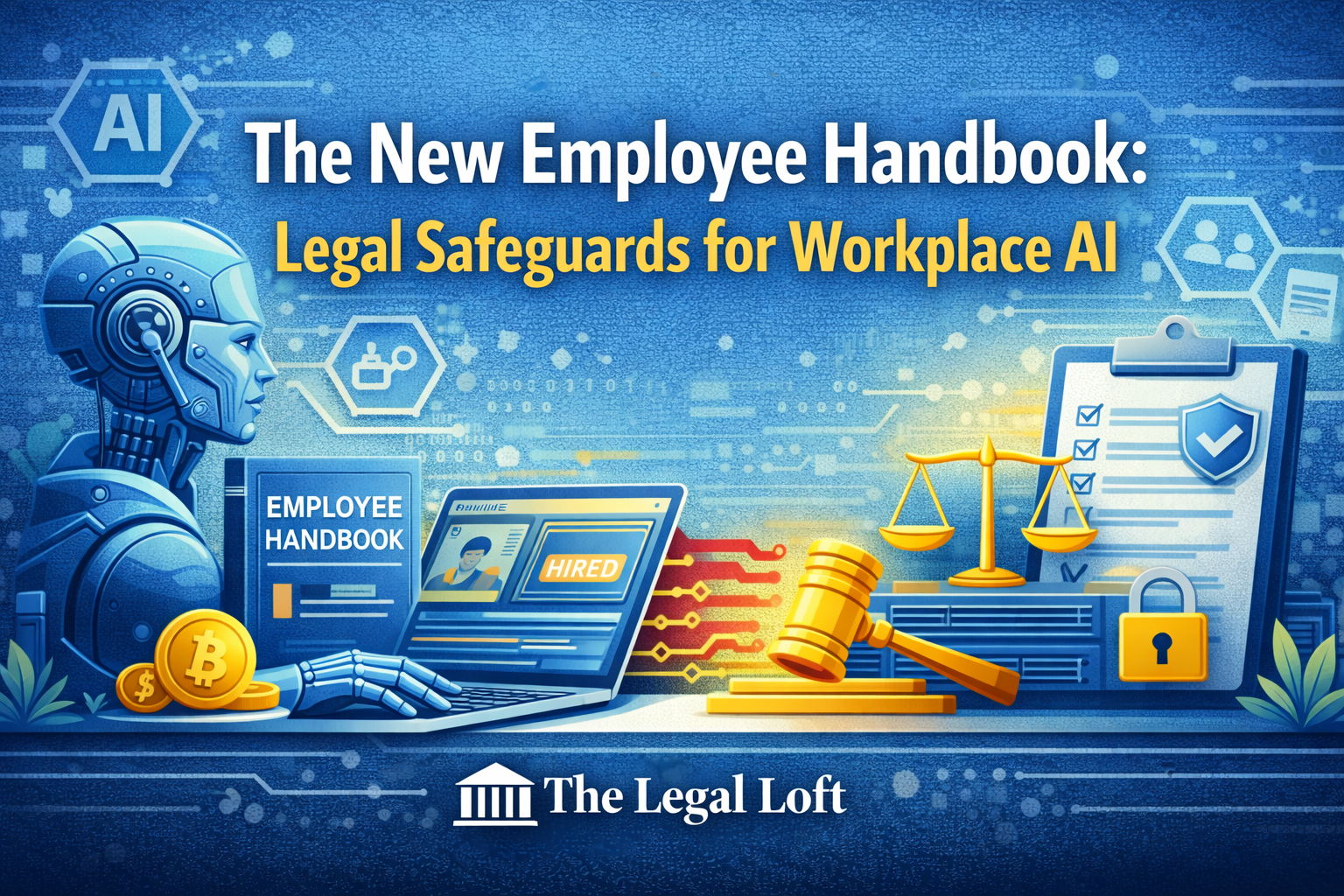
The New Employee Handbook is a legally aligned framework that governs how AI and automated tools are used in the workplace.
It integrates:
- Employment law
- Data protection principles
- AI governance standards
- Workplace ethics
Rather than banning AI, it ensures responsible, lawful, and transparent use.
Key Legal Risks of Workplace AI
1. Bias and Discrimination
AI trained on biased data can replicate or amplify discrimination related to:
- Gender
- Age
- Disability
- Race
- Socioeconomic background
Many jurisdictions treat algorithmic discrimination the same as human discrimination.
2. Employee Privacy Violations
AI-driven monitoring tools may track:
- Keystrokes
- Emails
- Screen activity
- Location
- Facial expressions
Without consent and purpose limitation, this can violate:
- Data protection laws
- Constitutional privacy principles
- Workplace surveillance regulations
3. Lack of Transparency and Due Process
Employees often don’t know:
- When AI is being used
- How decisions are made
- How to challenge automated outcomes
Opaque AI systems undermine natural justice in employment.
Core Legal Safeguards Every AI-Ready Handbook Must Include
1. AI Usage Disclosure
Employees must be informed about:
- Where AI is used
- What decisions it influences
- Whether decisions are automated or assisted
Transparency is a legal and ethical necessity.
2. Human Oversight Clause
No critical employment decision should be fully automated.
The handbook should guarantee:
- Human review of AI-driven decisions
- Escalation mechanisms
- Manual overrides
This protects both employees and employers.
3. Data Protection and Privacy Safeguards
AI-related data use must comply with:
- Consent requirements
- Purpose limitation
- Data minimization
- Retention controls
Employees should know:
- What data is collected
- Why it is collected
- How long it is stored
4. Anti-Discrimination and Bias Mitigation Policy
Organizations must commit to:
- Regular AI audits
- Bias testing
- Inclusive data practices
- Corrective measures
This aligns AI use with employment equality laws.
5. Employee Rights and Redress Mechanisms
The handbook should clearly state:
- The right to question AI-based decisions
- The right to explanation
- Internal grievance redressal processes
AI decisions must be challengeable, not absolute.
Regulatory Trends Shaping Workplace AI Governance
Globally, regulators are moving fast:
- EU AI Act classifies employment AI as high-risk
- Data protection authorities scrutinize workplace monitoring
- Courts increasingly recognize algorithmic accountability
- India’s DPDP Act emphasizes consent and purpose limitation
Even where AI-specific laws are emerging, existing employment and privacy laws already apply.
Why Startups and Tech Companies Must Act Early
Startups often adopt AI faster than large enterprises—but lack formal governance.
An AI-aware employee handbook helps startups:
- Scale responsibly
- Pass investor due diligence
- Avoid early-stage litigation
- Build ethical employer branding
For global startups, it also supports cross-border compliance.
AI Governance Is Now an HR Function
HR teams are no longer just people managers — they are AI governance stakeholders.
Legal, HR, and tech teams must collaborate to:
- Map AI usage
- Define accountability
- Update internal policies
- Train employees
The employee handbook becomes a living compliance document.
Conclusion: The Handbook Is the New Social Contract
As AI reshapes work, the relationship between employer and employee must be redefined.
The New Employee Handbook:
- Protects employee dignity
- Ensures legal compliance
- Enables innovation with accountability
AI may power the workplace—but law governs its limits.
Organizations that embed legal safeguards today will lead the future of work tomorrow.
Need Help Updating Your Employee Handbook for AI?
At The Legal Loft, we help companies:
- Audit workplace AI tools
- Update employee handbooks
- Ensure employment and data compliance
- Build AI governance frameworks
📩 Let’s make your workplace AI-ready — legally and ethically.